
Mike Hancock is the founder of Hancock Injury Attorneys, a former insurance defense attorney, and an AV-Preeminent–rated lawyer by Martindale-Hubbell, with over 35 years of experience practicing personal injury law.
Key Takeaways
- You can take these steps to correct or clarify a police report that is wrong by gathering a copy of the report, reviewing it carefully, gathering supporting evidence, and contacting the responding officer or department.
- From the moment of the accident, collect as much evidence as possible, including photos and videos of the scene, vehicle damage, and visible injuries, records of witness names and their contact information, a medical journal documenting your healing process, and all correspondence with law enforcement, insurance adjusters, and repair shops.
- If the police report is wrong and it is affecting your ability to recover damages, a Tampa car accident attorney can help by investigating your crash independently, working with accident reconstruction experts to determine fault, communicating directly with the police department and insurance company, and ensuring your version of events is fully represented in your injury claim.
Video Transcript:
The police report blames you for the accident. Can you still win? What if the official police report blames you, but you know you didn't cause the accident?
In Florida, the Florida traffic crash report does carry a lot of weight, but sometimes we know the police officer gets it wrong. Rarely does a police officer actually witness the accident happening. The police officer is left with talking with the various people involved in the accident and any witnesses to render an opinion as to who caused the accident and if anyone should receive a ticket for it.
Even if the police officer investigating the accident blames you for causing the accident and you know that's just not the case, the police report is not the end all be all as to who wins or who loses the case. If the police officer didn't witness the accident, he can't render an opinion at trial as to who caused the accident because that would be based on hearsay evidence.
Depending on the accident, we have various ways to prove that the police officer was wrong. The simplest of which is taking witness statements and talking to witnesses about how the accident happened. The second thing is obtaining video that might show the accident. The third would be recreating the accident based upon expert reconstructionists.
One thing that we've used a few times in the recent past is actually downloading your black box data. It's called the electronic data recorder. Every vehicle has it. And once you are involved in an accident, it automatically records 5 seconds before and 5 seconds after the actual collision.
We've been able to prove that the police report is wrong. In a specific case involving a rear-end collision of about four different vehicles, our client was in the middle vehicle and he swore to me that, "Hey, look, I was coming to a stop. I got rear-ended and pushed into the vehicle in front of me." He was taken away, he was seriously injured and taken away by ambulance and they didn't get his version of what happened at the scene.
But the other people blamed him for causing the accident. We were able to have his electronic data recorder, or what we call the black box, same thing as in an airplane, downloaded and reviewed by a forensic engineer who was able to clearly determine that he got rear-ended and pushed into the vehicle in front of him, not the other way around.
And we were successful in concluding that case for policy limits for our client in a case in which initially the insurance adjuster was telling me, "Hey, why are you even making a claim? Your client was the one who caused the accident."
If you have a situation where the Florida Traffic Crash Report blames you for causing the accident and you know that's just not the case, please call me at 813-915-1110. I'd be happy to consult with you and answer any questions you might have and come up with a game plan as to how we can be successful in concluding your case. The consultation's always free and we can do it over the phone. I'll be happy to answer any questions you might have.
The Police Report Got It Wrong - Can you Still win?
If the police report is wrong, it can jeopardize an otherwise strong car accident case. Insurance adjusters rely heavily on what’s written in that report, and if it’s inaccurate, it can put your case at risk.
If your Tampa car accident police report contains mistakes or leaves out key facts, you still have options. Here’s what you can do to protect your rights and strengthen your injury claim.
Common Police Report Mistakes That Affect Claims
Police reports play an important role in Tampa car accident injury claims, often serving as one of the first official records of what happened. However, even experienced officers can make errors in judgment or documentation. Here are some of the most common and most damaging types of car accident police report errors in Florida:
1. Incorrect Determination of Fault
Perhaps the most serious mistake is when the officer assigns fault incorrectly. The officer’s assessment is often based on quick observations and statements made under stress, not a full investigation. If you’re wrongly blamed for the crash, insurance companies will likely use that report to deny or reduce your injury claim. Adjusters and attorneys know that police officers are trained to list as Driver 1/Vehicle 1 the driver believed to be most likely at fault for causing the car accident, even if no citations are issued.
2. Client was not provided the opportunity to tell their side of the story
It is not uncommon for our clients to report being transported by EMS from the scene to the emergency room before having the chance to be interviewed by the investigating police officer or being unconscious at the scene. Our clients feel as if they were not given the chance to tell their side of the story.
3. Misstated or Incomplete Witness Information
Witness statements can make or break a case. But there are times when witnesses are left off the report entirely, or their statements are summarized inaccurately. In Hillsborough County, where intersections and traffic conditions can be complex, missing the perspective from a witness can change the entire understanding of how the accident happened.
4. Errors in the Description of the Crash Scene
The smallest factual mistakes, such as noting the wrong direction of travel, misunderstanding a lane change, or mixing up which vehicle was turning, can lead to confusion and misinterpretation later. These details can directly affect how insurance adjusters determine fault in a Tampa car accident claim.
Video Transcript:
The insurance company claims the accident was your fault. What should your next step be? Here’s how to push back when the blame game begins.
In almost every case, the insurance adjuster is going to first look at whether they can prove the accident was your fault, whether it was partly your fault, or whether it was all their insured’s fault.
That is the first consideration that insurance companies always have and insurance adjusters always have in their playbook.
They’re going to try to get you to give a recorded statement, and they’re going to ask you questions in a way that are meant to elicit responses that are detrimental to your own case.
In car accident cases specifically, we’ve had great success when our client comes to us and says, “Mike, the accident was not my fault, but the other driver said it was, and now that driver’s insurance company is blaming me for causing the accident.”
We’ve had tremendous success in those cases by employing the right experts — basically forensic engineers — to actually go to your car and download something called an electronic data recorder.
Every car these days has what’s essentially the same as a black box in an airplane. Those black boxes can be downloaded, and the information can be downloaded, and it’s a wealth of information.
When the other insurance company is claiming that you were going too fast, it will record an event. That’s the reason it’s called an event data recorder. It will record the event when you have an accident. It will record the five seconds leading up to that accident and the five seconds after the accident.
So if another driver is saying, “Well, your client was speeding at the time,” we can download the data to know exactly how fast you were going.
We had particular success in a case involving a multi-car rear-end collision accident where our client was right in the middle. Other drivers said he rear-ended the car in front of him before being rear-ended himself.
By downloading the electronic data recorder and having our expert review that data, it was objectively proven that he had come to a stop before getting rear-ended. We were able to tell how long he had been at a complete stop before being rear-ended, and our expert was able to calculate the speed at which he was rear-ended by the other vehicle.
That led to a great result.
It started off when our client came to us and said, “Just to let you know, they’re saying it was my fault.” I believed our client, and sure enough, we said, “We’ll just go ahead and get the EDR — electronic data recorder — evidence,” and it proved his case.
So that can oftentimes be the critical factor that helps prove the case when the other driver and insurance company are claiming that you caused the accident.
You’re not going to be able to really do that without an attorney.
I’ll be happy to walk you through your case. Please give me a call at 813-915-1110. I’ll be happy to consult with you. The consultation is always free. I help people every day, and I’d love to help you.
5. Inaccurate or Missing Injury Information
It’s common for police reports to say “no injuries” when accident victims don’t feel pain right away. Soft-tissue injuries, concussions, and back injuries often develop hours or days later. Unfortunately, that initial report can make insurers question the legitimacy of your injury claim later on.
6. Misidentification of Vehicles or Drivers
Officers occasionally record the wrong license plate, insurance information, or driver identity, especially when multiple cars are involved. In a busy area like downtown Tampa or near I-275, where multi-vehicle collisions are frequent, this type of mix-up can cause delays in identifying the at-fault driver or filing your claim correctly.
7. Missing or Incorrect Contact Information
A simple clerical error, like an incorrect phone number or address, can make it harder to locate witnesses, verify statements, or follow up with involved drivers. These small mistakes can lead to frustrating delays or even lost evidence in your case.
8. Omissions of Contributing Factors
Sometimes, critical factors such as speeding, distracted driving, or intoxication aren’t noted in the report. If the officer didn’t witness the crash and relies solely on driver statements, those details can be missed. This omission can make it harder to prove negligence in your Tampa injury claim.
When any of these errors appear in your Hillsborough County police report, they can create major obstacles in proving fault and recovering fair compensation. The good news is that these mistakes can often be challenged or clarified, with proper documentation and help from an experienced Tampa car accident attorney.
Steps to Correct or Amend a Police Report in Tampa
If you believe your police report is wrong, act quickly. In Tampa and throughout Hillsborough County, you can take these steps to correct or clarify your report:
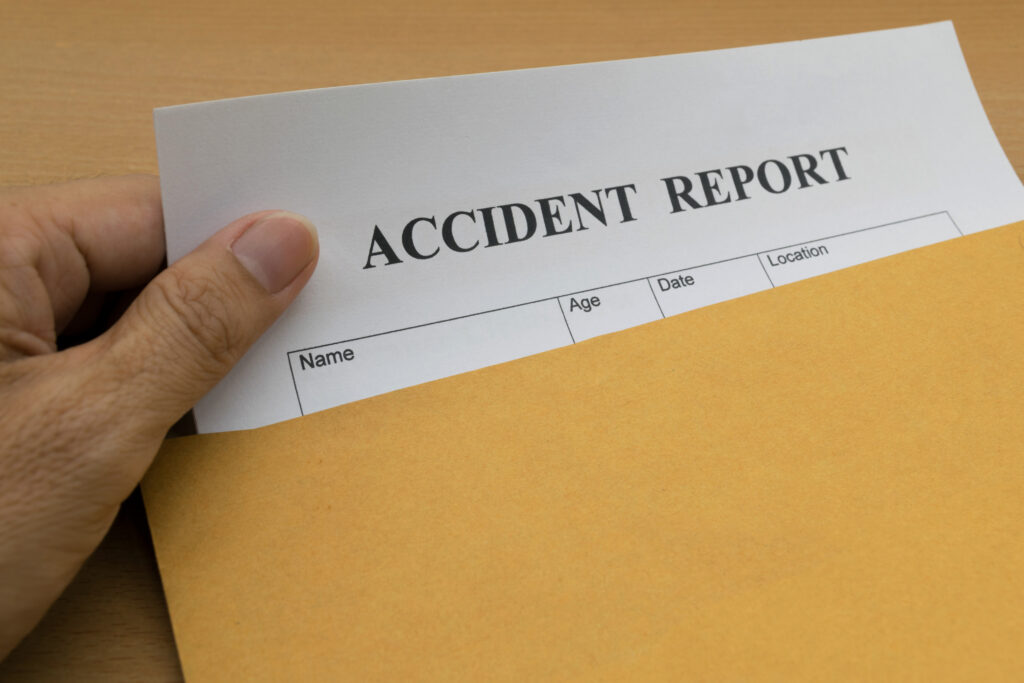
- Get a copy of the report. At the scene, you should be given a Driver Exchange of Information, which is a one-page crash report. Sometimes it’s emailed to our clients. The full Traffic Crash Report is multiple pages (usually 3-4 pages) with a lot more information, such as a diagram of the scene, witness statements, if citations are issued, and more. This full Traffic Crash Report usually takes 7- 14 days and can be downloaded from the Florida Department of Highway Safety and Motor Vehicles (FLHSMV) here.
- Review it carefully. Identify the specific errors, especially factual ones like location, witness names, or vehicle descriptions.
- Gather supporting evidence. Photos, dash cam video, medical records, or written statements can help prove the error.
- Contact the responding officer or department. A party involved in the crash can request that the police report be amended or supplemented. Politely explain the mistake and provide documentation. Many agencies accept written amendment requests or supplemental statements.
- Keep detailed records. Document every phone call, email, and letter related to your correction request.
While law enforcement may not change opinions, such as which driver is at fault for the crash or the investigating police officer’s narrative, you can submit a statement to become part of the official file. This record can be vital if the police report is wrong.
Why You Should Document Everything After a Tampa Car Accident
If the police report is wrong in your case in Florida, documentation is your strongest defense. From the moment of the accident, collect as much evidence as possible:
- Take photos and videos of the scene, vehicle damage, and visible injuries.
- Record witness names and contact info.
- Keep a medical journal tracking your pain levels, doctor visits, and diagnoses.
- Save all correspondence with law enforcement, insurance adjusters, and repair shops.
The more detailed your evidence, the easier it is for your attorney to challenge inaccuracies and protect your right to fair compensation under Florida law.
When to Get Legal Help When The Police Report Is Wrong in Tampa
If the police report is wrong and it is affecting your ability to recover damages, don’t face it alone. A Tampa car accident attorney can help by:
- Investigating your crash independently.
- Working with accident reconstruction experts to determine fault.
- Communicating directly with the police department and insurance company.
- Ensuring your version of events is fully represented in your injury claim.
At Hancock Injury Attorneys, we help accident victims in Hillsborough County correct the record and pursue the compensation they deserve. Whether you’re dealing with a factual mistake or a disputed fault determination, we’ll help you take the right steps to protect your rights.
We are here to help – call us today at 813-915-1110
If you believe your Tampa police report is wrong or you’re struggling with car accident police report errors in Florida, call Hancock Injury Attorneys at 813-915-1110 today. We’ll review your report, investigate the facts, and help you move forward with a strong, well-supported injury claim. Our phones and online chat are answered 24/7.

FAQs
Where can I get a copy of the crash report?
You can download a full copy of the traffic crash report on the website of the Florida Department of Highway Safety and Motor Vehicles (FLHSMV).
What evidence should I get after a Tampa car accident?
After a Tampa car accident, gather the following evidence:
- Photos and videos of the accident, vehicle damage, and visible injuries
- Names of witnesses and their contact information
- Keep a medical journal to document your healing process
- Save all correspondence with law enforcement, insurance adjusters, and repair shops